
Home
Giorgos Mountrakis, Ph.D.
Founder & Director | Intelligent Geocomputing Laboratory
Professor | Dept. of Environmental Resources Engineering | State University of NY College of Environmental Science and Forestry
Associate Editor | ISPRS Journal of Photogrammetry and Remote Sensing

Remote Sensing Methods: Deep learning for classification/regression, three-dimensional LiDAR processing, accuracy assessment, image fusion.
Interdisciplinary Studies: Land cover dynamics, socioeconomic patterns, environmental covariates, climate pattern analysis, forest consolidation dynamics, biodiversity responses, urban growth modeling.
CV
Dr. Giorgos Mountrakis is a Professor in Environmental Resources Engineering at the State University of New York College of Environmental Science and Forestry. He holds a Ph.D. from the University of Maine in Spatial Information Engineering and Science (2004). He is the Founder of the Intelligent Geocomputing Laboratory at SUNY-ESF. His areas of expertise include:
i) environmental monitoring using remote sensing methods (deep learning for classification/regression, three-dimensional LiDAR processing, accuracy assessment, image fusion),
ii) interdisciplinary studies linking land cover dynamics, socioeconomic patterns and environmental covariates (climate pattern analysis, forest consolidation dynamics, biodiversity responses to climate/land cover changes, urban growth modeling).
Dr. Mountrakis has been successful at securing external competitive grants from NASA, NSF, USDA Forest Service, USAID and Syracuse Center of Excellence. He has been the lead PI for approximately $3.4M in research funds, through individual and collaborative grants ($3.8M including Co-PI status). He has published in numerous journals and books and has presented his work in various national and international conferences. He is the recipient of several awards including SUNY ESF's Exemplary Researcher Award (2015), NASA's New Investigator Award (2008), ISPRS Excellent Reviewer Award (2012) and a Postdoctoral Fellowship from the National Academy of Sciences (2004).
His teaching is innovative through student-engaging activities (e.g. incorporating inquiry-based learning) and it includes courses in Digital Image Analysis, Spatial Statistics, Remote Sensing, Surveying, GPS and Artificial Intelligence in Geography. Notable service activities include being an Associate Editor for the ISPRS journal, chairing an ASPRS National Committee on Academic Engagement, Guest Editorship in the October 2008 Special Issue on "Artificial Intelligence in Remote Sensing" for the Photogrammetric Eng. & Remote Sensing Journal, and his involvement in a United Nations FAO Thematic Study on Trees Outside the Forest. In 2012 he was a Keynote Speaker at the 32nd EARSEL Symposium.
• SUNY ESF's Exemplary Researcher Award (2015).
• NASA's New Investigator Award (2008).
• ISPRS Excellent Reviewer Award (2012).
• Postdoctoral Fellowship from the National Academy of Sciences (2004).
Publications
+ identifies current or former graduate student.
[P01] G. Mountrakis (Inventor). Multi-scale radial basis function neural network. Full patent (#7,577,626) Issued August 18, 2009.
[63] Wang+, Z., G. Mountrakis and N. Pastick (2025). Deep learning approaches on Landsat observations: a review and meta-analysis. International Journal of Remote Sensing, 46(15), 5601–5627. [pdf]
[61] Wang+, Z. and G. Mountrakis (2023). Accuracy Assessment of Eleven Medium Resolution Global and Regional Land Cover Land Use Products. Remote Sensing 15 (12), 3186. [pdf]
[56] Khan, R.M.; Salehi, B.; et al. (2021). A Meta-Analysis on Harmful Algal Bloom Detection and Monitoring. Remote Sensing, 13, 4347. [pdf]
[52] Mountrakis, G., Li, J., Lu, X., Hellwich, O. (2018). Deep learning for remotely sensed data. ISPRS Journal, 145, 1-2. [pdf]
[50] Heydari+ S., G. Mountrakis (2019). A meta-analysis of deep neural networks in remote sensing. ISPRS Journal, 152, 192-210. [pdf]
[39] R. Khatami+, G. Mountrakis, S. Stehman (2016). A meta-analysis of remote sensing research on land-cover image classification. Remote Sensing of Environment, 177, 89–100. [pdf]
[34] G. Grekousis+, G. Mountrakis, M. Kavouras (2015). An overview of 21 global and 43 regional land cover mapping products. International Journal of Remote Sensing, 36(21), 5309-5335. [pdf]
[22] D. Triantakonstantis+, G. Mountrakis (2012). Urban growth prediction: A review of computational models. Journal of Geographic System, 4(6): 555-587. [pdf]
[10] K. Gunson+, G. Mountrakis, L. Quackenbush (2011). Spatial wildlife-vehicle collision models: A review. Journal of Environmental Management, 92(4):1074-1082. [pdf]
[09] G. Mountrakis, J. Im, C. Ogole+ (2011). Support vector machines in remote sensing: A review. ISPRS Journal, 66(3):247-259. [pdf]
[46] R. Khatami+, G. Mountrakis, S. Stehman (2017). Predicting individual pixel error in remote sensing soft classification. Remote Sensing of Environment, 199, 401-414. [pdf]
[41] R. Khatami+, G. Mountrakis, S. Stehman (2017). Mapping per-pixel predicted accuracy of classified remote sensing images. Remote Sensing of Environment, 191, 156–167. [pdf]
[25] G. Mountrakis, B. Xi+ (2013). Assessing Reference Dataset Representativeness through Confidence Metrics. ISPRS Journal, 78:129-147. [pdf]
[62] Mountrakis, G. and Heydari+, S. (2024). Effect of intra-year Landsat scene availability in land cover classification using deep neural networks. ISPRS Journal, 212, 164-180. [pdf]
[60] Mountrakis, G. and Heydari+, S. (2023). Harvesting the Landsat archive for land cover classification using deep neural networks. ISPRS Journal, 200, 106-119. [pdf]
[59] Pede, T.+, G. Mountrakis (2022). Towards daily maximum heat index estimation using satellite-derived products. International Journal of Remote Sensing, 43 (8), 2861-2884. [pdf]
[49] Pede+, T., G. Mountrakis (2018). An empirical comparison of interpolation methods for MODIS LST composites. ISPRS Journal, 142, 137-150. [pdf]
[48] Khatami+ R., G. Mountrakis (2018). The interacting effects of image parameters on impervious cover classification. Remote Sensing Letters, 9(2): 189-198. [pdf]
[47] S. Heydari+, G. Mountrakis (2018). Effect of classifier selection on per-pixel classification accuracy using 26 Landsat sites. RSE, 204, 648-658. [pdf]
[44] M.Y. Paltsyn, J. Gibbs, G. Mountrakis (2017). Estimation of Grassland Cover using MODIS. Rangeland Ecology, 70 (6), 723-729. [link]
[40] Z. Xu+, G. Mountrakis, L.J. Quackenbush (2017). Impervious surface extraction in imbalanced datasets. IJRS, 38(1), 43-63. [pdf]
[35] I. Manakos, E. Technitou, G. Mountrakis, et al. (2016). Multi-modal knowledge base for habitat mapping. European Journal of RS, 49, 1033-1060. [pdf]
[33] S. Yousefi, R. Khatami+, G. Mountrakis, et al. (2015). Accuracy assessment of classifiers in Iran. EMA, 187:641. [pdf]
[26] H. Jin+, S. Stehman, G. Mountrakis (2014). Impact of training sample selection on urban classification. IJRS, 35(6): 2067-2081. [pdf]
[20] H. Jin+, G. Mountrakis, P. Li (2012). Super-resolution mapping using variograms. IJRS, 33(24): 7747–7773. [pdf]
[17] L. Luo+, G. Mountrakis (2012). Multi-process model for impervious surface detection. IJRS, 33(2):365-381. [pdf]
[14] L. Luo+, G. Mountrakis (2011). Converting spectral information for impervious surface classification. ISPRS Journal, 66(5): 579–587. [pdf]
[12] G. Mountrakis, L. Luo+ (2011). Enhancing spectral information with structural inputs. RSE, 115(5):1162-1170. [pdf]
[11] B. Gong, J. Im, G. Mountrakis (2011). Artificial Immune Network for Land Use Classification. RSE, 115(2):600-614. [link]
[08] L. Luo+, G. Mountrakis (2010). Integrating intermediate inputs in hybrid classification. RSE, 114(6):1220-1229. [pdf]
[06] G. Mountrakis, R. Watts, L. Luo+, J. Wang+ (2009). Developing Collaborative Classifiers. PE&RS, 75(7):831-844. [pdf]
[30] H. Jin+, G. Mountrakis, S. Stehman (2014). Assessing PALSAR metrics in land cover classification. ISPRS Journal, 98:70–84. [pdf]
[45] G. Mountrakis, Y. Lee+ (2017). Gaussian Decomposition for waveform LiDAR. ISPRS Journal, 129, 200-211. [pdf]
[31] W. Zhuang+, G. Mountrakis, J. Wiley, C. Beier (2015). Forest Biomass Using Waveform Lidar. IJRS, 36(7), 1871-1889. [pdf]
[28] W. Zhuang+, G. Mountrakis (2014). Ground peak identification for waveform LiDAR. ISPRS Journal, 95:81-92. [pdf]
[58] H. Jin+, G. Mountrakis (2022). Fusion of optical, radar and LiDAR for land cover classification. ISPRS Journal, 187, 171-190. [pdf]
[38] A. Endres+, G. Mountrakis, et al. (2016). Importance of Landsat, LIDAR and PALSAR for biomass estimation. European Journal of RS, 49, 795-807. [pdf]
[29] W. Zhuang+, G. Mountrakis (2014). Ground peak identification using LiDAR and Landsat. International Journal of Digital Earth, 1-44. [pdf]
[24] H. Jin+, G. Mountrakis (2013). Integration of urban growth modeling and image analysis. IJRS, 34(15): 5468-5486. [pdf]
[57]Mountrakis G, Yang S.+ (2021). Linking Population and Forest Dynamics. Advances in Environmental Research, 2(1):8. [pdf]
[55]Mountrakis G, Yang S.+ (2021). Contributing Factors to Forest Loss. Advances in Environmental Research, 2(4):17. [pdf]
[53] Paltsyn, M.Y., J. Gibbs, G. Mountrakis (2019). Traditional Knowledge and Rangeland Monitoring. Environmental Management, 64 (1), 40-51. [pdf]
[51] Iegorova. L.V., J. Gibbs, G. Mountrakis, et al. (2019). Rangeland vegetation dynamics in Altai. Environmental Research Letters. [pdf]
[42] S. Yang+, G. Mountrakis (2017). Forest dynamics in the U.S. PLoS ONE 12(2): e0171383. [pdf]
[37] K. Pandit, E. Bevilacqua, G. Mountrakis (2016). Spatial Analysis of Forest Crimes. Journal of Geospatial Applications, 1(1), 3. [pdf]
[27] L.M. Giencke, M.Dovciak, G. Mountrakis, et al. (2014). Beech bark disease spatial patterns. Canadian Journal of Forest Research, 44:1042–1050. [pdf]
[32] G. Grekousis+, G. Mountrakis (2015). Sustainable development under population pressure. PLoS ONE 10(3): e0119675. [pdf]
[15] D. Triantakonstantis+, G. Mountrakis, J. Wang+ (2011). Spatially Heterogeneous Urban Growth Model. JGIS, 3(3):195-210. [pdf]
[13] J. Wang+, G. Mountrakis (2011). Multi-network urbanization model. IJGIS, 25(2):229-253. [pdf]
[07] G. Mountrakis, K. Gunson+ (2009). Moose-vehicle collisions spatiotemporal analysis. IJGIS, 23(11):1389-1412. [pdf]
[43] M.A. Petrov, et al., G. Mountrakis (2017). Glacial lake inventory in Uzbekistan. Science of Total Environment, 592, 228-242. [link]
[23] R. Khatami+, G. Mountrakis (2012). Classification in Hurricane Katrina Flooding Analysis. Remote Sensing, 4(12), 3877-3891. [pdf]
[18] B. Hong, K. Limburg, M. Hall, G. Mountrakis, et al. (2012). Monitoring framework for urbanizing watersheds. Environmental Modelling & Software, 32:1-15. [pdf]
[21] G. Mountrakis, W. Zhuang+ (2012). Multi-Scale RBF Network Training. PLOS One, 7(8): e40093. [pdf], [link]
[16] G. Mountrakis, A. Stefanidis (2011). Personalized Geospatial Queries. JGIS, 3(4): 334-344. [pdf]
[03] G. Mountrakis, P. Agouris, A. Stefanidis (2005). Adaptable User Profiles. Transactions in GIS, 9 (4), 561-583. [pdf]
[02] G. Mountrakis, P. Agouris, I. Schlaisich, A. Stefanidis (2004). Quality-Based Image Retrieval. PE&RS, 70 (8), 973-981. [pdf]
[01] P. Agouris, K. Beard, G. Mountrakis, A. Stefanidis (2000). Spatio-Temporal Gazetteer Framework. PE&RS, 66 (10), 1224-1250. [pdf]
[19] G. Mountrakis, D. Triantakonstantis+ (2012). Space balloon educational experiment. Journal of Geography in Higher Education, 36(3): 385-401. [pdf]
Grants
Cumulative award amount as lead PI or Co-PI: $3.8M, as lead PI: $3.4M.
- "A decision-making activity to guide archipelago-wide rewilding of Galapagos giant tortoises"
NASA Ecological Forecasting. Lead PI with James Gibbs. $797,000. 2021-2025. - "Developing novel deep learning classifiers for remote sensing imagery"
SRC Inc. Lead PI. $150,000. 2021-2025.
- "Spearheading new economic development while protecting tourism and access to potable water: Satellite-based harmful algal bloom detection in Onondaga County"
Onondaga County Economic Development. Lead PI. $100,000. 2019-2021. - "Developing advanced scientific capabilities and new economic opportunities from harmful algal bloom detection using remotely-sensed imagery"
Healthy Water Solutions Center of Excellence. PI with Tyler Smith. $10,000. 2020-2021. - "Management of Social–Ecological Grazing Systems in the Altai Mountain Transboundary Zone"
NASA. PI with James Gibbs. $779,000. 2015-2018. - "Developing advanced accuracy metrics for satellite-derived forestry products"
USDA Forest Service. PI with Steve Stehman. $128,386. 2014-2016. - "Engaging scientists and local herders as research collaborators to address grazing, poaching, and climate change issues in the Altai Mountain Region of Russia"
USAID. Co-PI with James Gibbs, Jennifer Castner, Mikhail Paltsyn. $99,655. 2012-2014. - "Using LIDAR to assess the roles of climate and land-cover dynamics as drivers of change in biodiversity"
NASA. PI with Bill Porter, Colin Beier, Lianjun Zhang, Ben Zuckerberg, Bryan Blair. $809,000. 2009-2013. - "Satellite-derived anthropogenic land use/land cover changes: Integrating detection, modeling and educational approaches"
NASA. PI. $359,341. 2008-2012. - "Establishing a Novel Forest Assessment Method: The Forestless Volume Indicator"
USDA Forest Service. PI. $120,000. 2008-2010. - "Bridging the temporal mismatch between remotely-sensed land use changes and field-based water quality/quantity observations"
Syracuse Center of Excellence. PI with Karin Limburg, Myrna Hall, Bongghi Hong. $100,000. 2008-2009. - "Incorporating Spatially-Explicit Uncertainty Metrics in Image-Derived Classification of Impervious Surfaces"
NSF. PI. $50,000. 2007-2008. - "An Integrated Monitoring/Modeling Framework for Assessing Human-Nature Interactions in Urbanizing Watersheds: Wappinger and Onondaga Creek Watersheds"
Syracuse Center of Excellence. Co-PI with Karin Limburg, Myrna Hall, Bongghi Hong, Peter Groffman. $300,000. 2006-2008. - "Monitoring Human-Induced Land Use Changes along the Great Lakes"
Great Lakes Research Consortium. PI. $10,000. 2006-2007. - "Synergetic Use of Satellite Imagery and Ancillary Data for Impervious Surface Estimation in the contiguous US"
National Academy of Sciences and USGS. PI. $80,000. 2004-2005.
Our Lab
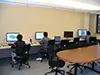
Dr. Mountrakis is the Founder of the Intelligent Geocomputing Laboratory in room 105 Baker.
• Eleven high-end workstations with 10-core CPUs.
• 64-core computational cluster.
• Access to NASA's and Syracuse University's supercomputing resources.
• Software: ArcGIS, Idrisi, Erdas Imagine, ENVI, Matlab, Python, Tensorflow.
Atef Amriche - Ph.D.: Training dataset selection.
Babak Asadollah - Ph.D.: Heat Index estimation.
Ahmadreza Safaeinia - Ph.D.: Deep learning on Landsat.
Zhixin Wang - Ph.D.: DNN computational reduction.
Teaching
Courses designed for variety of backgrounds. Classes typically have a large project.
Fall 2025
- Spatial Analysis (3cr) ERE621 Syllabus
Topics: spatial statistics, modeling for various data formats. Methods include spatial randomness, Ripley's K, variograms, kriging. Matlab required. Programming experience needed.
Spring 2026
- Principles of Remote Sensing (4cr) ERE365/ERE565. Syllabus
Introduction to fundamentals of acquiring, analyzing and utilizing remote sensing data. No prior experience necessary. - Environmental Machine Learning (3cr) ERE596, section 3. Syllabus
Introduction to machine learning and applications in environmental problems.
- Digital Image Analysis (3cr) ERE622. Syllabus
Digital image processing: enhancement, filtering, edge detection, morphology, recognition. Matlab assignments. - Surveying for Engineers (4cr) ERE371. Syllabus
Surveying principles and practices for engineering and construction management. - Introduction to GPS (1cr) ERE566. Syllabus
Theory and practice of GPS measurements. - Introduction to Spatial Information (1cr) ERE553. Syllabus
Basic spatial terminology, position methods, accuracy and precision. - ESF Goes to Space (1cr) ERE496.
Design, build, launch and retrieve high altitude sensor. - AI in Geography (1cr) ERE796.
AI methods: decision trees, fuzzy logic, neural networks, genetic algorithms. Graduate students only.
Service
Includes highlights of academic and professional service activities.
Chair of Review Committee on Promotion and Tenure.
Committee on Scholarship and Research.
Chair of Research Advisory Council.
Associate Editor for ISPRS Journal.
Guest Editor for AI in Remote Sensing (2008).
Chair, ASPRS National Committee.
Open Positions
Our lab receives many requests, we only have time to respond to dedicated students submitting all requested material - see expression of interest email instructions below.
Several research and teaching assistantships available starting August 2026, funded by NASA, ESF and others. ML experience and strong programming required.
Our lab has hosted numerous Fulbright students - email me directly to investigate collaboration.
Expected qualifications:
— Master's degree in engineering, computer science, physics, geography or related disciplines.
— Strong statistical and programming background.
— Experience with machine learning methods.
— Excellent English verbal and writing skills.
— Ability to collaborate and lead in groups.
Important: Emails without the two-page info sheet or GRE scores will not be considered.
- Edit this document, max 2 pages.
- Combine two-page pdf with CV into single pdf.
- Name: FirstName_Lastname_ESF.pdf
- Email to: [email protected]
- You will receive feedback within one week.
GRE Waiver: Available if you have 3+ English journal publications as primary author.
Environmental Resource Engineering – Geospatial Information Science and Engineering.
Environmental Science – Climate and Energy.
Environmental Science – Ecosystems: Land, Water and Air.
Media
Includes media coverage at national scale, not local/internal outlets.
Forest attrition study: S. Yang, G. Mountrakis (2017). Forest dynamics in the U.S. indicate disproportionate attrition in western forests, rural areas and public lands. PLoS ONE 12(2): e0171383.
New York Times: How Far to the Next Forest? A New Way to Measure Deforestation
Washington Post: Americans once moved away from forests. Now forests are moving away from Americans
Phys.org: Eye-opening study says rural US loses forests faster than cities
UPI: The forest is getting farther away, especially in rural America
Mashable: Hug a tree while you still can: U.S. forests are disappearing
Inverse: The Nearest Forest is Farther Away Than You Thought